


National Geographic 1989 October
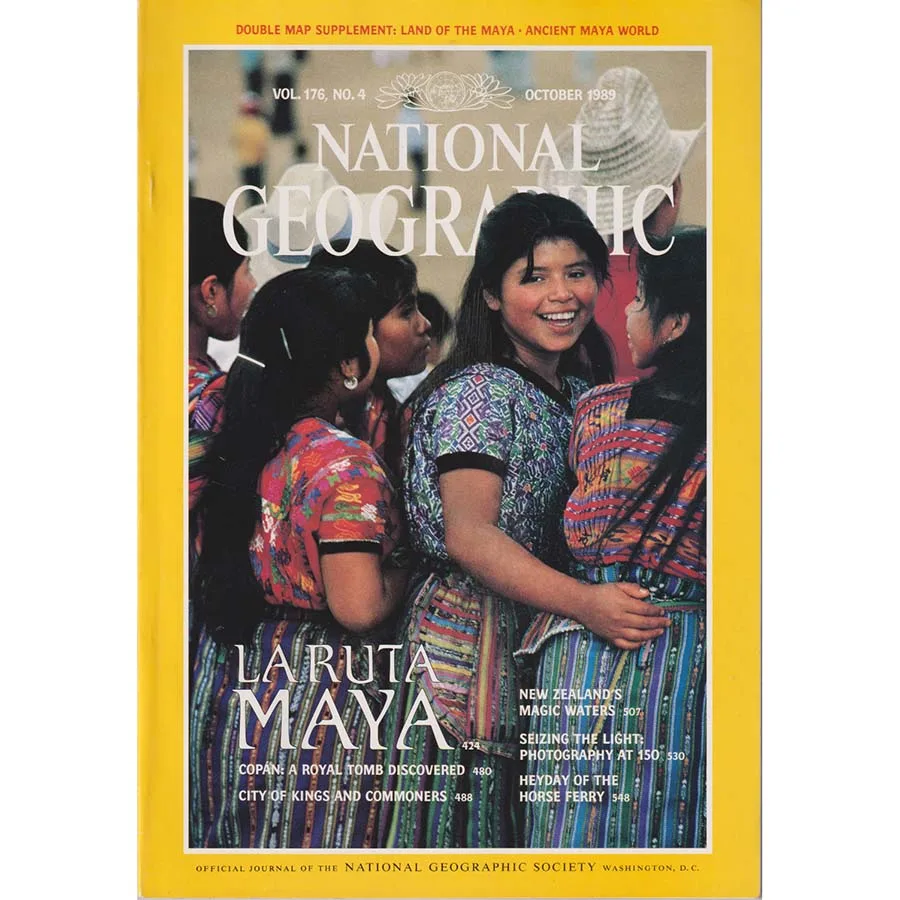
Publisher: National Geographic
Format: Paperback
ISBN: none
National Geographic, October 1989: the issue that turns up looking colourful, friendly, and completely unbothered… and then quietly hands you an entire civilisation, a royal tomb, and a double map big enough to temporarily annex your kitchen table.
The cover story is La Ruta Maya—a phrase that sounds like a charming travel plan until you remember it’s National Geographic, so it’s actually: “Let’s follow the Maya route through time, archaeology, living culture, and a frankly intimidating amount of history.” The cover photo does that classic Nat Geo thing: a bright, modern moment—women in richly patterned dress, laughter mid-conversation—anchoring a story that reaches back centuries. It’s a reminder (still useful, still necessary) that “ancient” doesn’t mean “gone,” and that heritage isn’t a museum label; it’s people, language, textiles, daily life.
Inside, the Maya thread splits into the best kind of rabbit holes. You’ve got Copán: a royal tomb discovered—archaeology at its most cinematic, where the ground gives up a secret and everyone tries to pretend they’re being calm about it. It’s the thrill of discovery paired with the weight of responsibility: once you unearth something, you’re in charge of how it’s told, how it’s protected, and how it’s understood. Nat Geo, in its late-80s golden age, loves this stuff: muddy boots, careful brushes, big questions.
There’s also City of Kings and Commoners, which is a beautifully blunt reminder that even the most dazzling civilisations weren’t all pyramids and priests—they were cities with class, labour, power, inequality, ordinary lives, and the daily logistics of getting through the week. It’s the sort of article that makes you see ruins differently: not as “mystery,” but as evidence of a society that was as complicated, brilliant, and messy as any other.
And then—because this issue clearly wants to spoil you—there’s the Double Map Supplement: Land of the Maya / Ancient Maya World. Which is Nat Geo’s way of saying: “Here, have an unfolding, paper-based sense of scale, and then fight it like a sail in a storm when you try to fold it back.” It’s delightful. It’s nerd heaven. It’s also a practical test of patience and spatial reasoning.
The supporting features add that classic National Geographic variety pack:
-
New Zealand’s magic waters – a cool, clean palate cleanser after tombs and temples: landscapes so beautiful they feel slightly unfair.
-
Seizing the light: Photography at 150 – a love letter to the medium that made National Geographic what it is. Expect history, technique, and the quiet flex of “we’ve been doing this a while.”
-
Heyday of the Horse Ferry – a wonderfully specific slice of transport history that sounds niche until you realise it’s basically about how humans moved through the world before engines made everything loud and hurried.
Condition: Good, which is perfect for a 1989 issue: sturdy, readable, and still thick with that pre-internet confidence—long articles, serious photography, and the assumption that you’ll happily spend an evening in another world. Sold by Crappy Old Books, naturally, because where else would you find a glossy portal to the Maya world plus a giant double map, without having to pretend you’re buying it “for the kids”?
If you like your travel with archaeology, your history with living culture, and your magazines with at least one fold-out that requires furniture clearance—October 1989 is an absolute keeper.
Keep browsing: See more National Geographic books Other books by National Geographic
